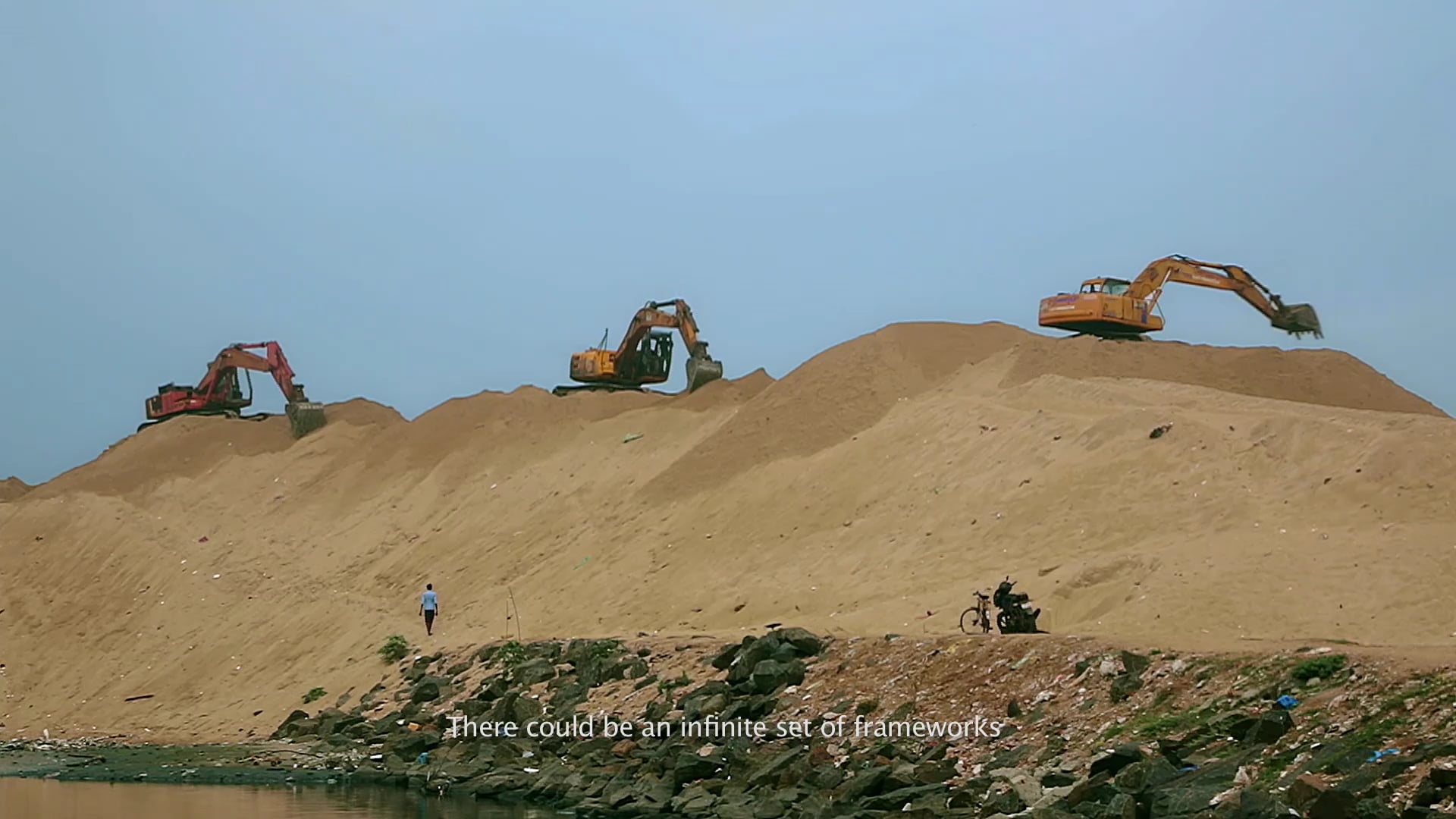
Neythal Diary
(Excerpt)
Total Runtime: 38 minutes, 42 seconds
Neytal Diary, (2016) HD Video with Audio 38 mins
Artist’s Note:
The didactic man-nature relationship raises the question – What is nature? Premodern ways of imagining nature, present other relationships beyond the subject/object binary. Ancient Tamil Sangam akam love poetry, is one, where five landscapes, Kurinji (mountains), Mullai (forests), Marutam (agricultural lands), Neytal (sea), and Palai (desert), reflect an internal terrain of feelings – of sexual union, yearning, sulking, pining, and separation. The poems, from a literary tradition in old Tamil, suggest other ideas of nature, where the subjectobject co-form each other.
Today, the planet is in an ecological crisis. Nature has been reduced to an object which can only be ‘acted’ upon through it being ‘extracted,’ ‘admired,’ ‘enjoyed,’ etc. but not ‘lived’ with. The relationship is one of power. Capital, technology, mass production, resource exploitation, have all prospered though this positioning. Wilderness has been privatized, forests fenced, rivers tamed, and animals made extinct. There seems no going back from consumption, and progress. It is the age of the power of man, as the Anthropocene, Climate Change and the Sixth Extinction predict. No one can guarantee future survival.
Current ecological thoughts like those of eco-philosopher Timothy Morton assert that the category of ‘nature’ itself needs to be discarded altogether, and reassembled as a network of human – nonhuman relationships. Also, the eastern proposition of a non-dual self, offer clues to where to look. Nature defined merely by science needs to be re-read alongside with ideas of mortality, fragility, vulnerability, balance, equity and democracy.
2
This work proposes a dialogue between the idea of nature as evoked in premodern Sangam poetry and that as reflected in present day ecologically depressed coastal Tamil landscapes, to suggest other sustainable futures.